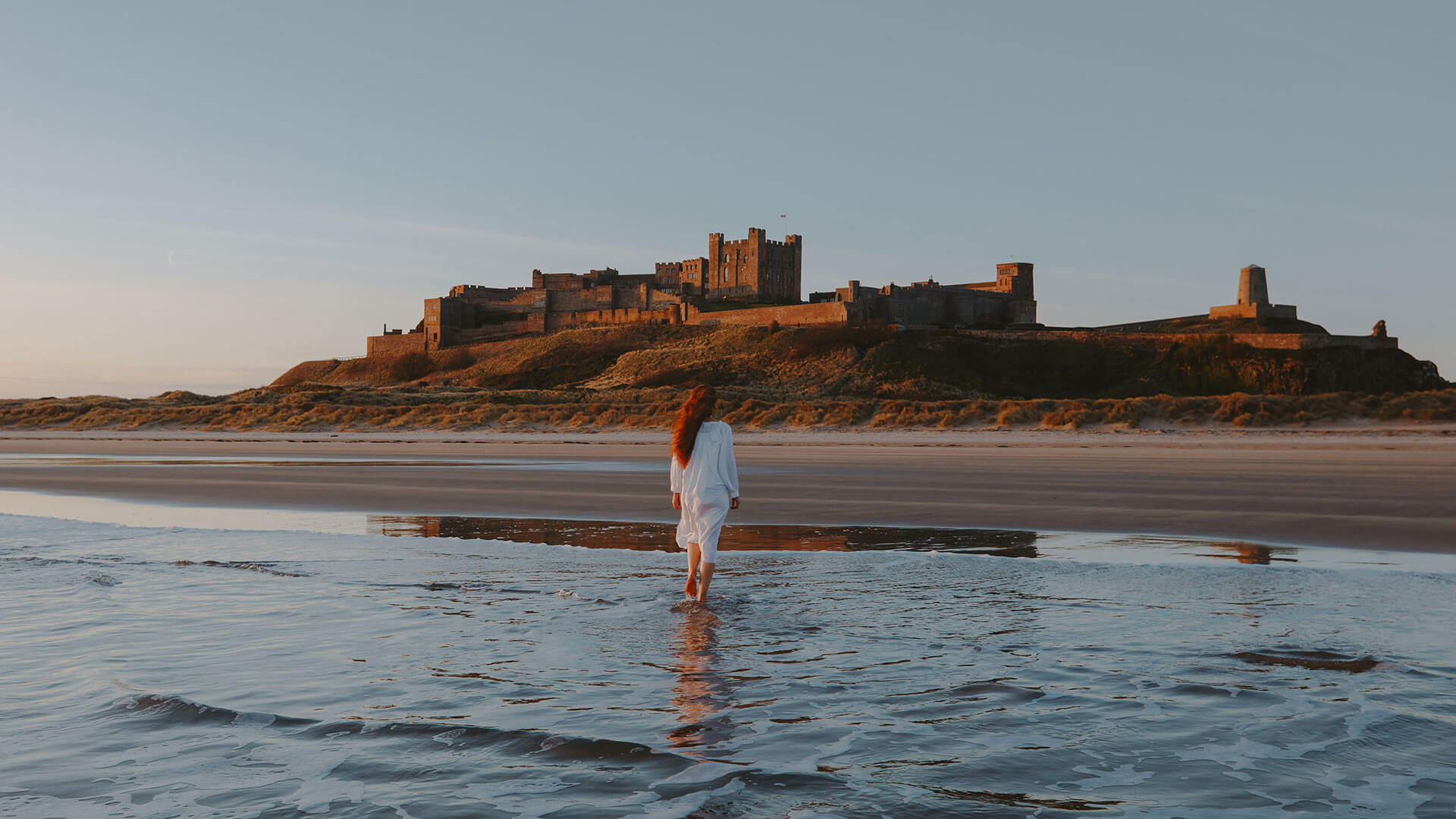
Let's start with arguably the two most famous. There's Bamburgh Castle, an ancient site completely remodelled and rebuilt by Victorian entrepreneur Lord Armstrong, who also built Cragside House, Gardens & Estate
Try standing on Bamburgh beach one sunny morning or sunset and marvel at the site of the fortress towering over the dunes looking out defiantly towards the North Sea.
Do the same at Embleton beach and you'll find yourself looking towards the ruins of Dunstanburgh Castle, a fortress built in the 14th Century. It was a view loved by landscape artist Turner.
Coming inland, but staying in the north of the county, Alnwick Castle dominates its town and you may recognise it from its starring role as Hogwarts in the Harry Potter series of films.
Northumberland's countryside was a prize asset for the Scots and the English and as a result you'll find fortresses and pele towers peppering the county.
The brave can stay at the allegedly haunted Chillingham Castle or you can sample the award-winning luxury of Langley Castle Hotel.
As if that wasn't enough, we can offer you Hadrian's Wall World Heritage Site, Holy Island, a range of significant battlefields and the mysterious carvings of ancient peoples who left their distinctive cup and ring marks on rocks around the county.
Beautiful gardens, woodland walks, a Prime Minister and a famous cup of tea! Enjoy Snowdrops, Daffodils, and Rhododendrons in spring; the Bog Garden, Borders and Terraces in summer; and brilliant autumn colour in the woodland walks.
A spectacular castle with fantastic coastal views. The stunning Kings Hall and Keep house collections of armour, artwork, porcelain and furniture.
The first purpose-built barracks in England, Berwick Barracks is now host to three museums. The Main Guard houses 'The story of a Border Garrison Town' exhibition.
Berwick's town walls are its most famous piece of architecture and still stand strong today, hundreds of years after they were built.
Walk the footsteps of the soldiers who fought on the Flodden Battle field nearly 500 years ago. It is hard to conceive today of the carnage that took place there on the 9th September 1513, when surveying the rolling hills.
Tour the Old Gaol, 1330AD, by glass lift. Meet the gaoler, see a Reiver raid and try on costumes.
Spacious perpendicular style church with many medieval features, e.g., Hotspur pillar. 1464 charter of Henry VI that two 'burgesses' of Alnwick rebuilt their church. Patronage of Dukes of Northumberland; Percy connection.
St. Cuthbert’s Cave is an overhanging outcrop of Sandstone rock, supported by an isolated pillar of stone. It is reputed that the monks of Lindisfarne brought St. Cuthbert’s body to this place in AD875 following Viking raids on the Island
A church was founded on this site in 635 by St Aidan; the site of his death is marked by a shrine within the present church which dates from the end of the 12th century. A squint, a fine reredos, and a memorial to the Victorian heroine are amongst some of the many treasures of this delightful parish church.
Situated in the heart of the market town of Hexham, Hexham Abbey is one of the earliest surviving Christian foundations in Britain. Originally a Benedictine Abbey, then an Augustinian Priory and the Parish Church of Hexham.
Woodhorn celebrates Northumberland. Stunning new architecture and listed colliery buildings house fascinating displays, galleries, interactives and amazing archival treasures. See paintings by the famous Pitmen Painters here too.
Described by Simon Jenkins in his "England's Thousand Best Churches" as a "mini-Durham Cathedral".
Visit this beautiful and rare Civil War Church. Opened in 1652 - it is the only parish church built under Cromwell. The church contains one of the earliest installations by Lutyens, a John Knox Renaissance pulpit, and panels from the 13thC Castle.
Visitors may inspect the remains of the Roman fort and settlement, see its extraordinary finds in the superb museum. Full-scale replicas of Roman buildings. Please ring to check winter opening times.
The museum is housed in the historic Berwick Barracks and contains historical town artefacts and part of Sir William Burrel's art collection.
With its interesting mixture of architectural styles and impressive location, this 13th century church provides visitors with a site of notable historical interest and an individual look.
Largely medieval church displaying the evolution of a well-developed 13thC church from a Norman core. Carvings in stonework and a turret clock dated 1796.
Late Saxon West Tower, 12th Century porch, original long lancet windows at east end.
The Church was founded in the 12th century and retains some of the Norman stonework. The South Chapel of Our Lady contains the 15th century tomb of Sir Ralph Grey and his wife Elizabeth.
A small, serene, historic church, which is more than 900 years old and is still in use regularly for Sunday services and weddings etc.
This beautiful Saxon church is a hidden gem nestling in the rolling countryside of mid -Northumberland. An oasis of calm in today’s world of noise and rush. Spirituality and a sense of peace seem to seep from its ancient stones.
St Michael & all Angels is a Grade 1 listed building set in a conservation area in the village of Felton, Northumberland. The church and its beautiful churchyard, a previous Northumbria in Bloom winner, provide a tranquil place to pause, reflect and feel at one with God.
See the tower through the gates. Come inside the Norman building. See lancet windows, stone carvings, a village school room, and fire damaged walls outside.
Blanchland got its name from the white habits worn by monks of the Premonstratensian order who founded Blanchland Abbey.
Contemporary art gallery with a programme of events by Berwick Visual Arts.
An ancient and interesting Church, full of historical information, a quite, peaceful sanctuary.
Twelfth-century Grade 1 church. Burned down by Border Reivers. Rebuilt with rare barrel-vaulted stone roof.
14th Century church, Roman tombstone, medieval grave covers, exquisite windows, historic churchyard, 18th century carved headstones, two medieval stone coffins.
St. Paul's Church dates from 1200 and was rebuilt in 1849. A tranquil ancient sacred space and historically important Flodden Battlefield church.
A delightful hilltop church believed to be the location where King Oswald (604 -642) raised a large wooden cross before the Battle of Heavenfield (AD 635).
Beautiful light 14th century Grade 1 listed church in which Capability Brown was baptised. This little church consists simply of a nave and chancel, but has striking interior features.
Beautiful 13th century church with a long history of worship by local families through the centuries.
'More to this church than meets the eye' (Pevsner). A site of Christian worship since the 11th century or earlier, the chancel and south transept date from the late 15th century.
Medieval church with Saxon foundation (737 AD), remarkable vaulted chancel. Also Hermitage nearby.
The remains of a medieval castle, superseded by the most complete and impressive bastioned town defences in England.
Ancient Parish Church, over 700 years old, set in a peaceful churchyard with a glorious fourteenth century Tree of Jesse window.
The oldest building on Holy Island, the only building that retains work from the Saxon period. It is very likely that St. Aidan worshipped on this site from arriving in 635 AD.
Results: 87